



If you think about a world before sticky tape, you might think of a slower, perhaps gentler pace of life, where people had time (for example) to tie string around parcels wrapped up in brown paper, and fix sealing wax to the knot, to ensure the probity of the mail service. Now we are so accustomed to ripping another length of sellotape/parcel tape/duct tape/masking tape to whatever needs it that we forget what a boon it all is.
We are most certainly in favour of quality adhesives at the framing workshop. Without it, your picture would fall to bits. Which is Not Good. It’s a decent reason to get to know the canon of assorted glues and tapes available so that the appropriate treatment can be ‘prescribed’ for each piece of art.
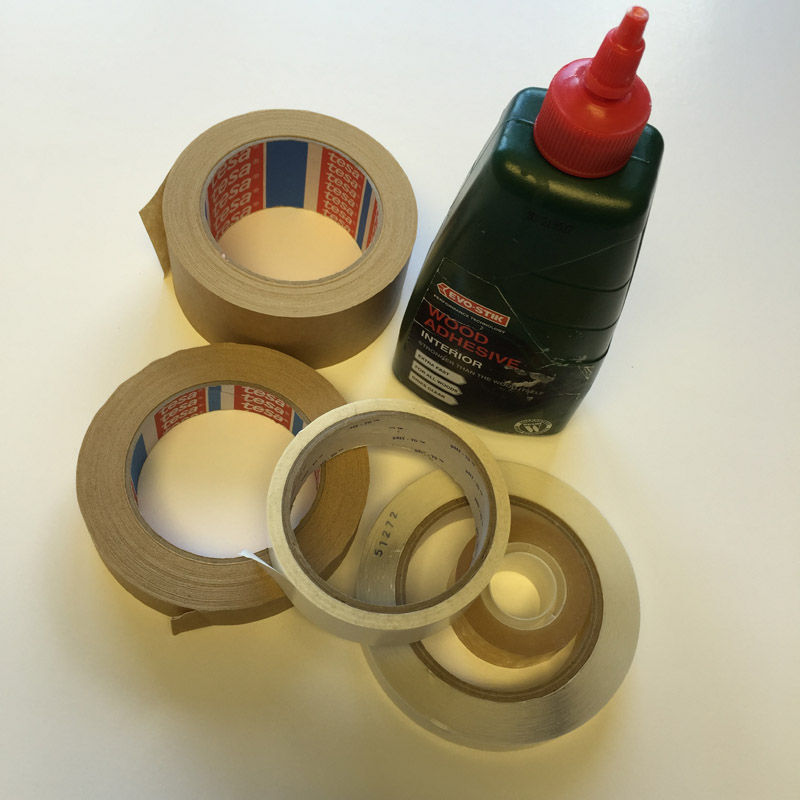
Our assortment of adhesives…
We don’t use the flimsy gummed backing tape that you see on many a vintage picture any more (good for its time, but it has a nasty habit of coming adrift at exactly the same moment that the glue in the frame corners decides to give up the ghost, and the results can be messy). Masking tape has its place, but not in our workshop. It’s great for keeping paint at bay for a short time, but it dries out and gives up the ghost within months, thereby relinquishing its job of sticking whatever it was supposed to be sticking.
We use a high-quality brown tape, made by Tesa, which has the great virtue of being forgiving for the first hour when attaching it – if you get in a mess, you unpeel it and start again, and it is kind enough to let you. It comes in three different widths, so we select according to the depth of the frame you have chosen, and the width distance needed to cover the end of the points inserted to hold your piece in place (see last week’s post).
The importance of proper taping of an artwork cannot be overstated – it helps hold the whole together; it acts as a barrier to Evil THRIPS; it neatens the back of a picture and helps keep the entirety of your artwork as firmly held as possible. Our tape is tough enough to stay put for years, meaning you can enjoy your picture without worrying that the back of it might come adrift at some point.
The other tapes in general use are the special one we have to hold your art in place under the mount, which is PH neutral, so it won’t damage the image in any way. As is explained elsewhere on the site, an image needs to ‘hang’ inside a frame, so that the different expansion and contraction of the components do not distort it in any way – damp and heat being the principal culprits. PH7-70 tape holds your artwork firmly and safely to the mount, while the glass and frame and other three sides of that board can shift minutely without your picture moving in the wrong direction.
Double-sided tape we use to hold special bits and bobs onto a mount board where you don’t want to see any glue parts. Jolly handy stuff.
Lastly, we tend to use pva wood glue to hold the frame assembly together. It’s tenacious stuff, easy to clean off the excess and sets pretty quickly. We apply to the cut edges of the frame before holding them tight in a right angle, underpinning the corners, and it usually does a grand job of holding it all together. Unless you do as I did last week, and dutifully undo the top bit of the lid to squirt the glue onto the frame edges, only to squidge the entire top off the bottle (inevitably full) with very, very messy results…there is still a sticky spot on the carpet next to the underpinner which is a complete giveaway that I didn’t check the bottle top before applying the glue.
I think I shall have to stick to taping from now on.