



A friend asked me over for coffee recently, and the conversation turned to framing (it does that when I’m around. Funny, really). We were discussing the best way to set off canvasses, and I opined (thoughtlessly) that any canvas that was expected to adorn a wall without benefit of frame would always look a little unloved. Well, wouldn’t you know, my lovely friend had one just so in her dining room, and asked me to take it away immediately and put it in a frame. Which of course I duly did.
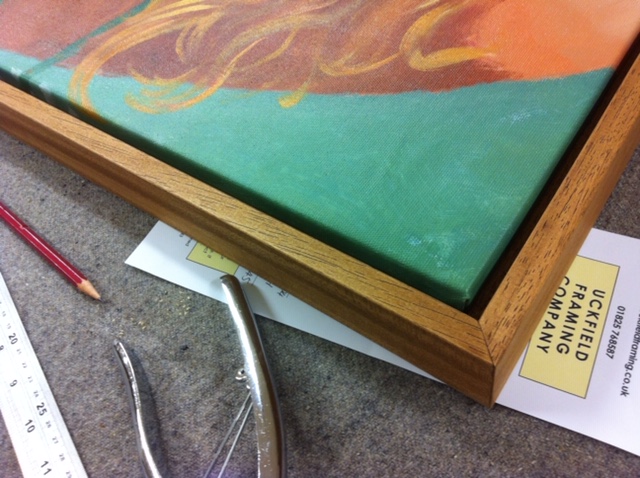
Canvas in a tray frame…
There is a school of thought that the ‘naked’ edge of a canvas is perfectly OK to have on view, and of course, we have stretched many canvases in our time and handed them over to happy customers in their bare state. But we do tend to prefer a more finished look, either by dropping the canvas into a tray frame, or, more elaborately, we place a ‘frame within a frame’ for some pictures, which allows us some latitude (and fun) with inner colours which can pick out or offset a principal colour within the picture. Often this creates area of calm between a busy painting and its frame, in much the same way a window mount sits around a watercolour.

Canvas in a gold and cream stacked frame…
There are other good reasons for this, not all of them aesthetic – the first and most important one is that a frame protects the outer edges of the image, where bashes and scratches can do considerable harm to the canvas itself. Another is that many (most) canvases are stretched unevenly, and it is irritating to the purist eye when a picture is not properly square and true when hanging on the wall. A good frame will even out any distortions and direct the eye to where it should be – the image itself.
Tilly