



Our post this week will certainly be filed under miscellaneous, but might justifiably be described as quite random! There is a point to look forward to after a little digression, so please be patient. In a rather more personal post than usual I am going to talk about art, but specifically the art of motorcycle maintenance, and yes; its relevance to picture framing!
As many of you will know, one of my passions (other than work of course), is motorcycling. Riding particularly, but increasingly finding out more about what makes my motorcycles tick. This is partly out of necessity, but also because it is engaging, satisfying (when it works), and occasionally surprisingly creative! Being fundamentally creative people, us picture framers obviously need to satisfy these tendencies whatever we are doing.
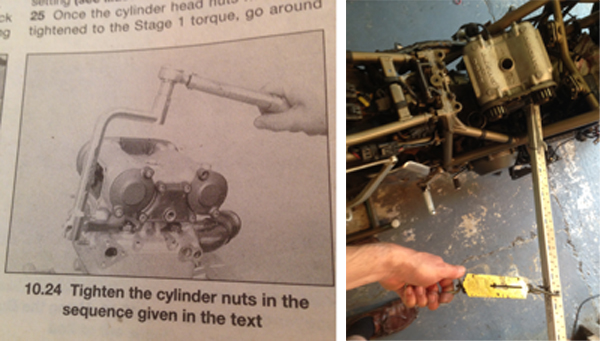
Tightening the cylinder nuts…
Each cylinder is firmly fixed in place with four largish nuts, whose degree of tightness is fairly critical, and therefore requires measuring, usually with a torque wrench. The location of these nuts in recesses within the head means it is impossible to get a socket onto them, and therefore the only advice available, including that given in the venerable Haynes manual, is to beg, borrow or buy Ducati service tool 88713.1139 for £100 or more. But, (and yes at last here’s my point), with a bit of lateral thinking it is possible to improvise a cheap and easily available alternative ‘special tool’: a length of metal with a spanner attached to one end and a spring balance 500 mm from the nut centre works a treat!
[For those wanting to try this at home on your own Ducatis.. the final tightening of these nuts to 52 Nm of torque, requires a force of 104 N at 0.5m, and 104 N corresponds to a weight of 104/9.91 = 10.6kg.. so pull until the spring balance shows a tad over 10kg (about 23 lb).. thanks Des for the maths]
The other ‘special tool’ required when reassembling a four valve desmodromic Ducati engine is service tool 88765.0999, essentially a gauge to measure the tautness of the toothed cam belt. Too tight and the pulley bearings will suffer, but too loose and the valve timing will not be accurate, or at worst the belt may come off leading to a high speed valve/piston collision! (I could bore you by describing two such incidences.. but don’t worry, I won’t here). You can see the Ducati tool in the Haynes manual photo below, which attaches to the cylinder head to measure the belt tension between the camshaft pulleys. And in the other picture you can see that the good old spring balance is once again pressed into useful service as an alternative ‘special service tool’; a pull of 5kg (around 11lbs) on the belt midpoint via a cable tie achieves perfect belt tension!
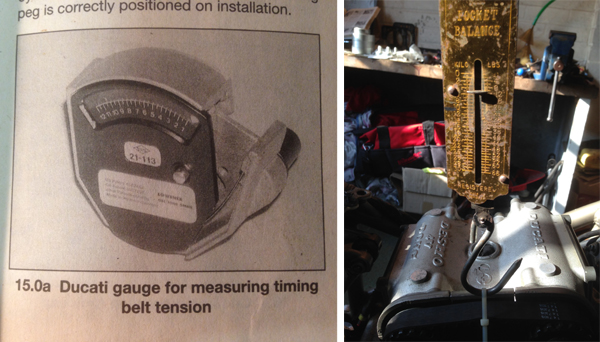
Measuring timing belt tension…
Which finally brings me to the point of the post! That a bit of lateral thinking can produce satisfying alternative ways of doing things.. maybe cheaper, even quicker.. in either case better. And back to picture framing: a few weeks ago I posed a question; to find a simple and fast alternative to measuring/calculating to find the approximate ‘one third’ point of a picture frame side, in order to position the D-rings. And the answer lies in this prototype now undergoing extensive laboratory testing..
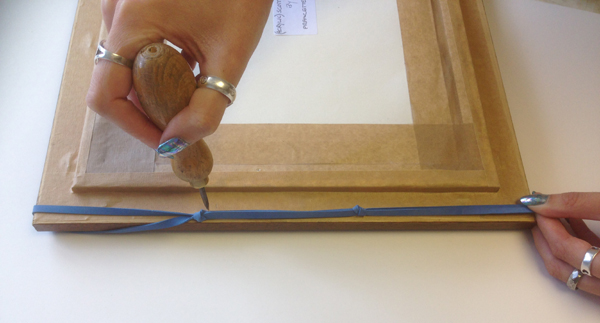
Measuring one third with the prototype.. ..how simple and quick is that?
[Thanks to my evening class focus group.. and particularly Bob for coming up with this solution]