



When Tim asked me to write about framing two Vettriano pieces this week, one of which is The Singing Butler, it behoved me to do a little digging about the artist – we have all seen the iconic group on a rainy beach scene at some point, but what is it about Vettriano that draws such polarized views, methought?

This Singing Butler, framed in LJ black/iron Chantry moulding with a double mount of cream and red, is probably the no 1 best selling art print
Born Jack Hoggan in 1951, this is a self-taught artist who is Marmite to the art establishment. The Singing Butler was rejected by the Royal Academy for its Summer Exhibition in 1992 – but went on to garner a wallet-walloping £744,500 at auction in 2004. According to The Guardian, Vettriano earns half a million pounds a year in print royalties – which is rather one in the eye for the self-same art establishment, one would think.
Leaving school at 16, the artist was variously an apprentice mining engineer and bingo caller (you really couldn’t make it up, could you?). He started painting as a hobby in the 1970s, when a girlfriend bought him a set of watercolours for his 21st birthday. One really hopes he remembered to say Thank You. His early pieces were produced under his birth name, Jack Hoggan, and were mainly copies or pastiches of impressionist paintings – his first painting was a copy of Monet’s Poppy Fields.
In 1987, aged 36, Jack Hoggan metamorphosised into Vettriano (his mother’s maiden name), moved to Edinburgh and applied to study Fine Art at the eponymous university. His portfolio was rejected. Vettriano refused to take the hint.
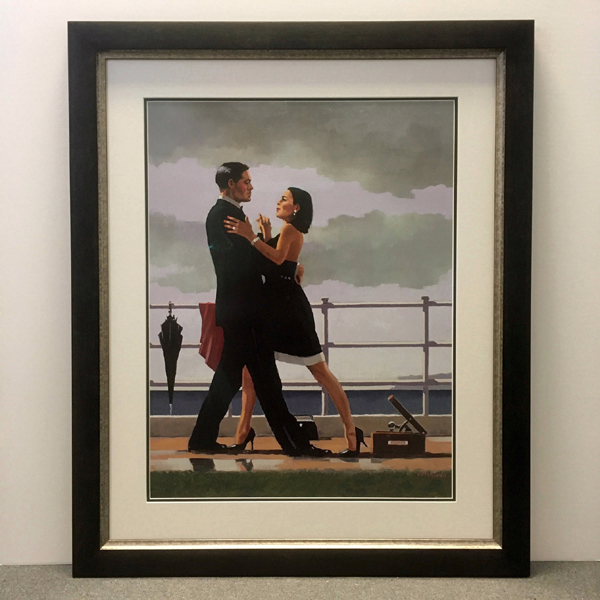
Anniversary Waltz, with its double mount of cream and grey
Two years later he submitted two canvases to the Royal Scottish Academy annual show – both sold on the first day, and the roller coaster of sales gathered apace from then. Easel paintings cost between £48,000 and £195,000 new and hugely successful exhibitions have been held as far afield as Hong Kong and Johannesburg, cementing his place in the artistic firmament, to the delight of his many admirers and the chagrin of the sniffier parts of the art world.
Tilly