



I had been thinking for some time that I should construct a wooden box, perhaps a puzzle box with some intricate hidden key, to present as a surprise for my daughter, when out of the blue she asked me to make a cookbook stand for her. No specification of course: it just had to fit in with her new light oak kitchen and, oh, it should have a cat motif of some sort – again unspecified but possibly a carving.
So the designer in me kicks into action to create a book stand the Queen would be proud to own – this should be interpreted as something that is far too complex and fiddly, and will take an inordinate length of time to make and finish.
I start by designing the masterpiece using a 3D computer modelling programme until I have something that fits the criteria: I can make it; it’s in oak; there is somewhere for a cat motif and I want it to look like a book even when it doesn’t have a cookbook sitting upon it.
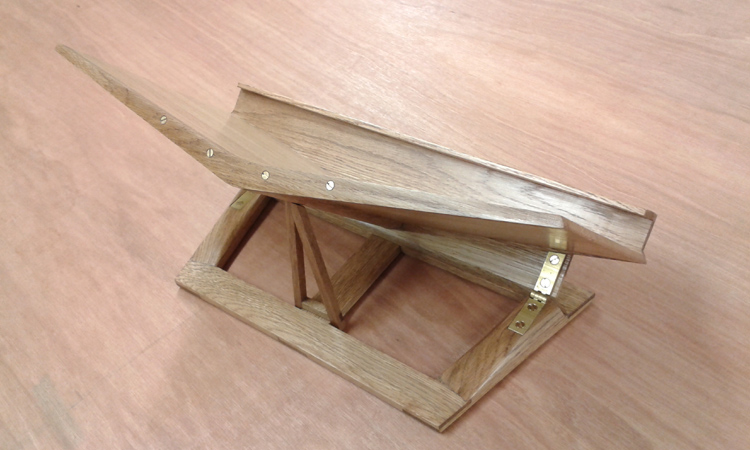
A view of book stand from top…
Off I go to Tim’s Uckfield Framing Company Tuesday woodwork class and cut up the oak I have bought into thin, one inch high, tapering strips and glue them together to form the ‘pages’, then fashion a spine and glue the pages to it with a running mortice and tenon. A shallow ‘V’ shaped piece is glued and screwed (brass screws with oak to stop the staining that would happened between the tannin from the oak and steel screws) to the top of the pages to finish and strengthen them. The book support goes on next and the hinge plate is screwed to it. Finally I find some solid brass hinges: a bit expensive but this is a labour of love. The base comes together with six halving joints fashioned with saw, chisel and a handheld router plane. Gluing them together is fun: the angles make it a little tricky to clamp and to keep the whole assembly flat. It all comes together and is starting to look the part. A brace is needed to support the hinged back so a small ‘A’ frame is fashioned out of some oak strip my father-in-law had given me decades ago so there is a bit of family history in there as well.
The oak is scraped, sanded smooth and coated with four or five layers of finishing oil. And what of the cat motif you may ask. Should I carve, never having carved before, or print a picture onto the oak? I found a technique whereby an image from a laser printer can be transferred onto a surface which did not require any particular level of skill, just a lot of patience. It works! Then the whole piece-de-resistance is coated in beeswax to give it that finishing sheen.
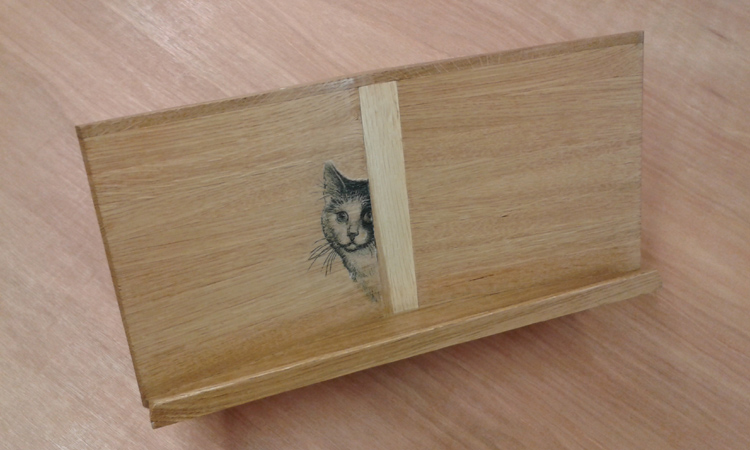
Book stand from the front showing cat motif…
How many hours did it take? An uncountable number. Forty or fifty? I’d guess closer to two hundred! Did my daughter like it? No – she loved it: it was so much more than she expected. Was it worth it? Definitely: my daughter has something to remember me by.
Martin
Great to read your blog. I love my bookstand and it sits very proudly in my new kitchen. Xx
Glad you like your book stand Tracey, Martin really enjoyed designing and making it, and then of course writing about it!