



Sometimes the work we do in the studio can give us all serious pause for thought. Good art does that, of course, but there are sometimes artefacts that come into the workshop which go beyond – they engage the imagination, and whet the desire to know more about that particular piece and its backstory.
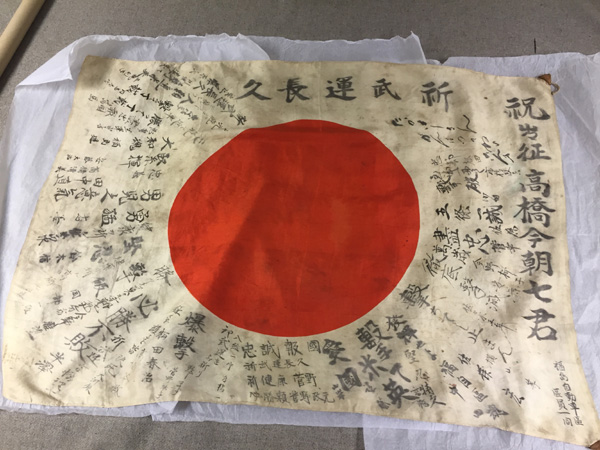
Studying the inscriptions upon the flag…
Such is the beautiful Japanese silk flag which we framed recently. Carried by a Japanese soldier into Burma during the Second World War, inscribed with exhortations to the carrier, taken by Allied forces from a shack in the jungle in Burma where an injured soldier lay and brought home as a memento of war. It is impossible to look at it without imagining the agonized slice of history to which it bears testament.
From a practical point of view it is not a particularly difficult thing to frame – with something as powerful as this, simple is always best, so it has been unfurled and placed in a deep frame and gently fixed with tiny nylon ties to the back so as not to inflict any damage to the fabric. The ‘glass’ is actually acrylic, and both UV-protective and scratch-resistant. It will hang in the home of a descendent of the man who brought it home to England after the war was over.

The finished frame complete with flag…
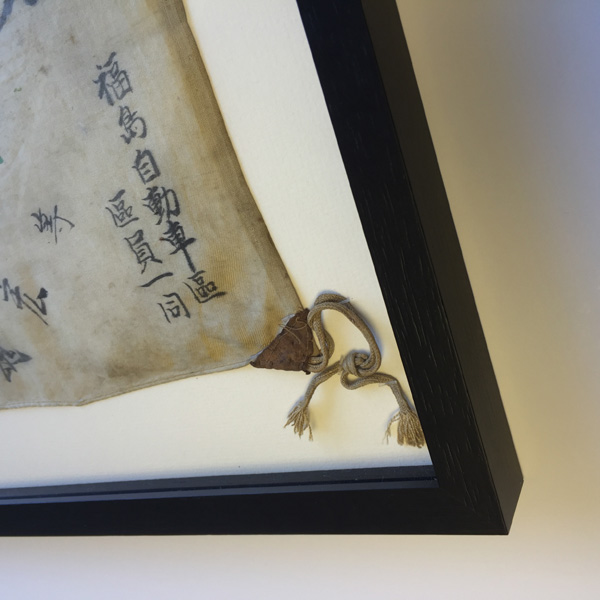
Close up of the flag showing the almost invisible fixings…
Some thought and research has gone into the framing of it – not least to make sure that it is both ‘right side up’ and ‘right way out’, so that was thoroughly checked before it was put into the frame; translations of some of the inscriptions have been obtained, wishing success to the (presumed) original owner, one Kesahighi Takahashi: “Do your best Mr Takahashi, from Gojo”; “Please win the war”; “Beat the Americans & English & Siamese!”; “Fight to the end, from Sato” and several others.
The flag was captured in or around August 1944, seemingly just after the Battle of Kohima, where the Japanese forces were prevented from invading India. The capture is described in a book titled “March On” by Norman Havers MBE (who was a lieutenant in the 2nd Battalion The Dorsetshire Regiment).
It does make one wonder if it was Mr Takahashi who was that injured soldier; whether he survived; how he felt at losing his cherished flag, and, perhaps, whether his descendants know that it might have been considered a legitimate trophy of war at the time, but it has been treated with care and honour since, and will continue to be so.
Tilly
Remarkable. A moving story. Simple has indeed framed the flag perfectly