



While the process of putting a picture in a beautiful moulding, mounted to display the best features of the image, and protecting the whole from deteriorating, is massively satisfying, sometimes it’s the silly, surprising improvements that can give the greatest pleasure in our work. A good ‘huff’ of breath across a dusty image often does the business; a light rub with an eraser can get a stubborn mark out. Occasionally we flick a bit of crud (see previous posts on The Not-at-all Technical Guide to Framing Terms) out of an image with a sharp scalpel or razor edge. All can make a surprisingly big difference to the overall ‘clean’ look of your picture.
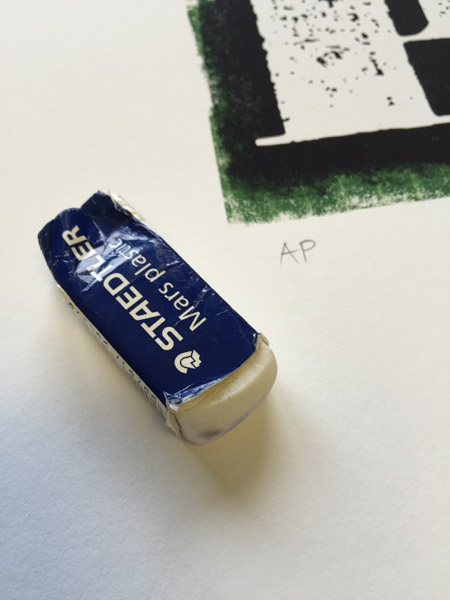
Our trusty eraser…
Some things, however, are a big No-No (I have learned these to my chagrin):
– Never ‘Huff’ a pastel if it has not been fixed (a spray to ensure the colours stay put);
– Don’t attack an elderly or fragile piece of paper with a scalpel unless you are on really, really good terms with the art owner;
– use rubbers/erasers with extreme caution…they can destroy the texture of paper in a heartbeat.
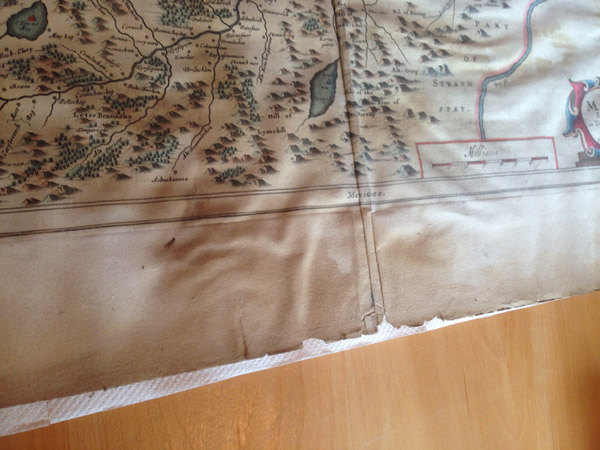
The water-damaged map before…
A useful hint if your image/artwork is a bit battered and buckled is to sandwich the paper/card between two large sheets of glass and ignore it for a judicious amount of time. Obviously we have the capability to do that in the studio, and if left for long enough, it can have quite remarkable results on a less-than-smooth piece of artwork. Developing the idea further, recently I had a badly water-damaged map which was rippled with the moisture and looked dreadful. It responded to a heat treatment courtesy of a Hot Press (which we also have in the studio – usually used for ‘ironing’ posters and such to dry mount them onto a card backing). Because the item was so damaged anyway, it was worth the risk of heating it to try and improve its surface, obviously without trying to glue it to anything, just a dry heat application. I wouldn’t try it with anything where there is a risk the inks might ‘bleed’ but in this instance it worked like a charm.
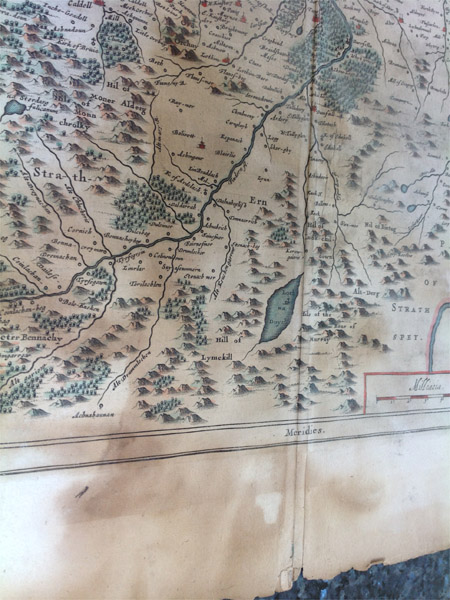
..and after!
Sometimes the obvious march of time is an important part of the character of a piece of art. Too tidy can be too bland, and the speckles and age spots of an antique should be cherished rather than banished. Sensitivity to the type, period and style of any picture is something you learn on the job, and all part of the fun of the varied projects we do here.
In the main, however, our mission is to return your artwork to you in as good as – or better – nick as it was when it arrived in the workshop, which is why we will always err on the side of caution when it comes to ‘improving’ an image.
Tilly
As usual I learned some interesting new facts about a subject I didn’t even know was interesting – until I started reading this blog!