



Any new activity comes with a language to learn, kit to get used to and its own received way of doing things. Half the fun of taking up something new is getting the brain cells to dance a little more vigorously and in directions they haven’t travelled before.
Doing things the right way matters, which is why I wanted to learn from Tim and Natalie.
Because I am a complete novice, every working day brings a new experience, and if I am lucky, the beginnings of a new skill. What I don’t have is any preconceived ideas about the ‘how’ things should be done, which can mean that occasionally I can do something a little out of the ordinary and unexpected. This can be good!
Certain conventions in framing are plain logical – many black and white photographs DO look better with a pale or white mounting board with a thin black bevelled edge around the image (called Black Core). It just works well and projects the picture out at the viewer.
Ditto posters. Many have been designed with a view to just being pinned to a wall, so it’s a sensible approach to put them in a simple frame.
Not always, though. I have a poster from the 80’s which was suffering in a tatty old metal frame with a Perspex ‘glass’ which had gone milky and scratched over time.
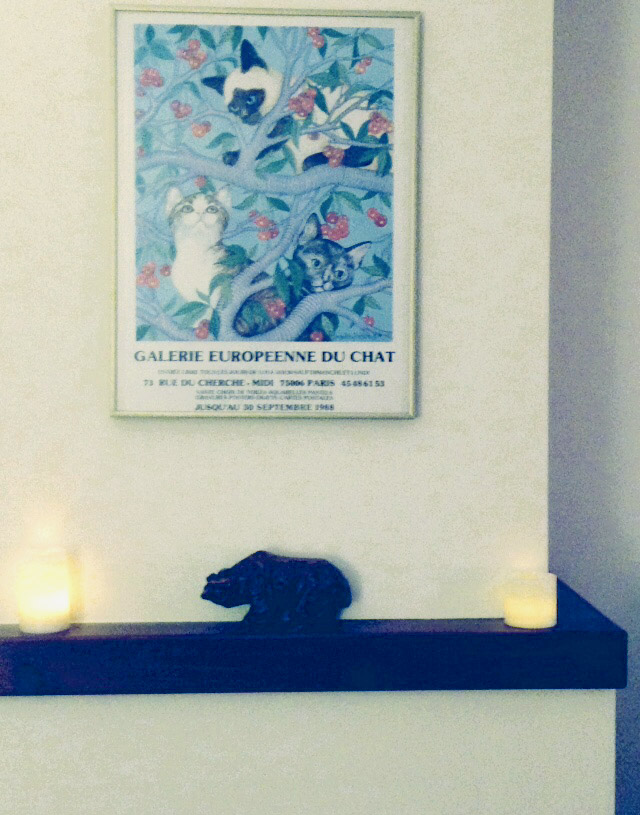
The poster before it was reframed…
Because at that stage I didn’t know that you usually just put a simple frame on a poster without a mount, I had some fun instead, and the result looks pretty good to me (and the family likes it, which is more to the point). It’s a picture that takes me back to a certain place and time, so because it is important to me, it was worth the extra effort and expense of a more lavish setting. It would have looked fine in a simple frame, but I think it looks great as it is now.
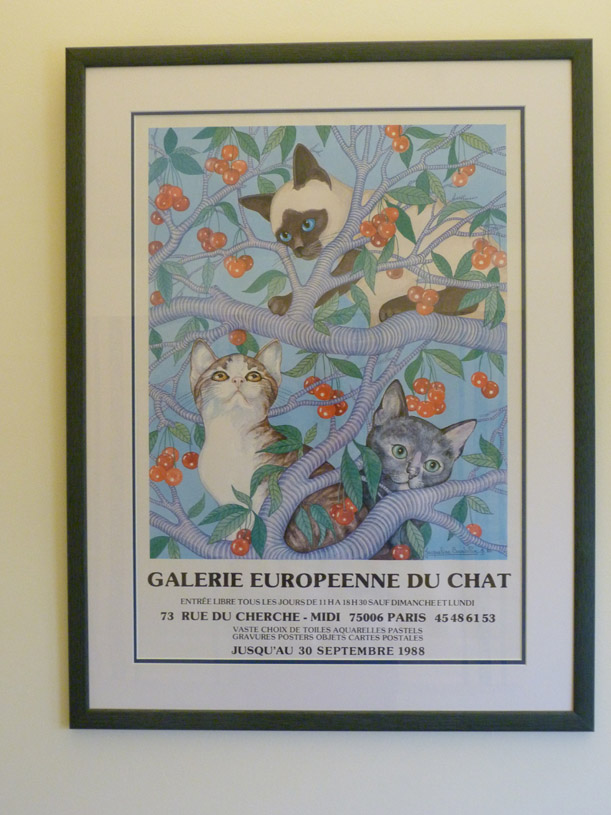
…and after!
The same goes for anything you care about. It’s how you choose to present it that matters, not what ‘The Rules’ say.
As an example: Some people get rather sniffy about people choosing art to suit existing colour schemes in their homes. While I wouldn’t do it myself, I don’t disdain it for other people: Your home, your colour scheme, your budget, your choices.
You don’t have to slavishly follow the rules if there is something that appeals to you that you would rather do. If a certain colour scheme or style of frame speaks to you, that is the only thing that really matters. So…break the rules…a bit. You might surprise yourself!
Submerge the photo in warm water. After removing the photo from the glass, it sholud be dipped in a product such as Kodak Photo-Flo, then hung to dry. This is a product that lessens the tension of the water on the print, and allows it to dry spot free. Just a quick dip is all it takes, then you could use a photo squeege (very carefully) on it to get most of the liquid off before drying. There are some photographic papers that will curl badly when drying. These need to be sandwiched in a drying pad, specific for the purpose. Any decent size camera store sholud have the items, or at least tell you where you can get them.When you try to peel the photo from the glass, do it *very* slowly. If it sticks too much, don’t force it, and give it more time in the water. I have soaked photos for two or three days before being successful. Occasionally, there will be a print that will not release, but most of them will.Next time, mat the photo so it will not touch the glass.